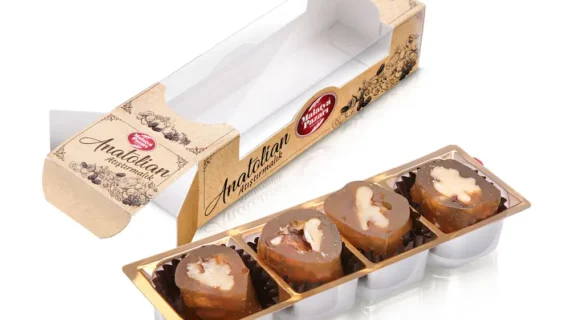
The Crown Jewel of Anatolian Confectionery: The History, Craft, and Chemistry of Cevizli Sucuk
🏛️ Historical Roots and Cultural Significance
🔬 The Science of the “Herle”: Ingredients and Mechanics
- The Structural Core (The Nuts): Large, undamaged, light-colored walnut halves are preferred. They must be fresh enough to retain their natural oils but dry enough to prevent mold growth beneath the coating.
- The Liquid Base (The Must): Freshly pressed juice from grapes, mulberries (dut), or carob (harnup) is used. This juice is simmered in large copper cauldrons to reduce its water content and concentrate the natural fructose and glucose.
- The Clarification Agent: In traditional village methods, a mineral-rich white clay known as pekmez toprağı is added to the boiling juice. This clay binds to organic impurities and neutralizes excess acidity, leaving behind a clear, sweet liquid ideal for confectionary work.
- The Thickener: Wheat flour and native starches are slowly whisked into the cooled juice to form a smooth slurry. When reheated, these starches undergo gelatinization—a process where starch granules absorb liquid, swell, and burst, transforming the juice into a thick, glossy, pudding-like paste called herle.
🪵 The Step-by-Step Artisanal Craft
Threading: Using a heavy-duty needle and thick cotton twine, individual walnut halves are meticulously pierced and pushed down the string. The nuts must face the same direction and sit snugly against one another to eliminate gaps where air might get trapped.
The First Bath: The long strands of walnuts are lowered entirely into the hot, bubbling herle. The artisan gently swirls the string to ensure the paste penetrates every crevice of the uneven walnut surfaces.
The Drip and Set: The string is slowly lifted, allowing excess pudding to cascade back into the cauldron. It is immediately hung from wooden racks to cool. As the starch cools, it sets into a soft, rubbery jacket around the nuts.
Layering (Optional): For a premium, thick-skinned variety, the strings are allowed to dry for 24 hours before being dipped a second or third time. This creates a dense, chewy outer coating that contrasts beautifully with the crunch of the interior.
Curing: The coated strands are moved to a well-ventilated, shaded drying area. Direct sunlight is avoided, as rapid moisture loss can cause the outer skin to crack, exposing the nuts to pests and air. Over the course of 3 to 7 days, the moisture content drops to a critical point where the exterior turns into a firm, non-tacky, elastic leather.